Royal camp before La Rochelle
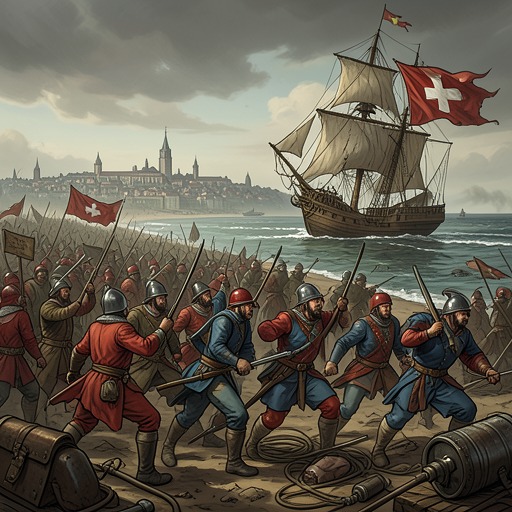
The Three MusketeersThe Royal camp before La Rochelle is the principal French military setting of the siege, but it is more than a collection of quarters, trenches, and commands. It is the point where the machinery of the French monarchy, the rivalry between Louis XIII and Cardinal Richelieu, the Anglo-French conflict, religious policy, and the private adventures of d'Artagnan converge. Within the camp, military operations are shaped by illness, factional command, hunger, naval access, weather, and intelligence, while individual loyalty and ambition remain exposed to the same pressures.
Strategic and Political Setting
The camp exists because La Rochelle is the last major refuge left to the French Huguenots after the other fortified cities surrendered under Henry IV. Richelieu presents the city as the remaining bulwark of Calvinism, a center where civil revolt and foreign war can mingle. Its harbor is also the last port in the French kingdom open to England, so closing it would both weaken the Huguenot resistance and deprive England of a strategic foothold in France. The siege therefore joins religious policy, internal state consolidation, and international rivalry rather than constituting a merely local military operation. The same political logic extends beyond France. Spaniards, Englishmen, Italian malcontents, adventurers, and soldiers of fortune from different confessions gather beneath the Protestant standard, making La Rochelle the focus of a dispersed European network. The camp consequently faces not only a city but an international coalition whose branches reach across Europe. Richelieu's campaign is represented as both a national military enterprise and an attempt to reorganize the kingdom's political and religious order. The siege also has a private motive embedded within its public one. Buckingham claims to defend England's honor, yet he wants to enter France as a conqueror rather than as an ambassador and is pursuing a personal vengeance. The narrative identifies the hidden stake of the conflict as a favorable look from Anne of Austria: two powerful kingdoms are drawn into a contest shaped by the desires of two powerful men. The Royal camp thus becomes the physical arena in which courtly passion is translated into fleets, armies, fortifications, and prolonged suffering.
Command, Quarters, and Military Organization
D'Artagnan reaches the camp before La Rochelle on September 10, 1627, after the king's illness delays the royal advance. Louis XIII develops a fever after leaving his Bed of Justice and is forced to halt at Villeroy; because the Musketeers halt whenever the king does, d'Artagnan is temporarily separated from Athos, Porthos, and Aramis. His arrival at the camp therefore restores him to the principal theater of war but not immediately to the companionship he values. The military organization of the camp reflects the political rivalries at the top of the army. Bassompierre and Schomberg, both marshals of France, claim the right to command under the king, while Richelieu supports the Duc d'Angouleme as lieutenant general because he distrusts Bassompierre's Huguenot sympathies. To prevent the marshals from abandoning the army, the command is divided. Bassompierre holds the northern sector between Leu and Dompierre; the Duc d'Angouleme commands from Dompierre to Perigny; and Schomberg occupies the southern sector from Perigny to Angoutin. The placement of the leading figures turns the camp into a map of surveillance as well as warfare. Monsieur is quartered at Dompierre, the king alternates between Estree and Jarrie, and Richelieu establishes his quarters on the downs by the bridge of La Pierre in a simple house without entrenchments. Monsieur watches Bassompierre, the king watches the Duc d'Angouleme, and Richelieu watches Schomberg. Command is therefore distributed through mutual observation, with military deployment preserving political balance as much as preparing combat. D'Artagnan belongs to the Guards rather than the Musketeers when he arrives. The Guards under M. Dessessart take up quarters at the Minimes, but d'Artagnan has formed few attachments among his comrades because his ambition is to enter the Musketeers. He feels isolated and left to his own reflections. The camp intensifies rather than resolves his personal uncertainty: Madame Bonacieux has disappeared, his prospects in love and fortune have scarcely advanced, and he has made an enemy of Richelieu, a man before whom even the greatest figures of the kingdom tremble.
The English Threat and Material Conditions
Before d'Artagnan reaches the camp, Buckingham has seized the initiative. He appears unexpectedly before the Isle of Ré with ninety vessels and nearly twenty thousand men, surprises the Comte de Toiras, and lands after a bloody conflict. Toiras withdraws into the citadel of Saint-Martin, while a hundred men reinforce the smaller fort of La Prée. The English, masters of the island, continue unsuccessfully to besiege both positions while French forces begin operations against La Rochelle. The Royal camp confronts this threat through material conditions as much as through tactical brilliance. The English soldiers suffer from poor provisions, living on salt meat and bad biscuit, and many become invalids. Rough seas destroy small vessels along the coast, leaving the shore between l'Aiguillon and the trenches covered at every tide with the wrecks of pinnaces, roberges, and feluccas. These conditions steadily erode the English position. Even without a French assault, it appears that Buckingham, remaining in the island through obstinacy, will eventually have to raise the siege. The French nevertheless act because intelligence reports that the enemy is preparing another assault. Louis XIII orders a decisive action. The campaign to drive the English from the island succeeds: the English are repulsed in successive encounters and defeated while crossing the Isle of Loix, forcing them to re-embark. They leave two thousand men dead, including five colonels, three lieutenant colonels, two hundred and fifty captains, and twenty gentlemen of rank. The French also capture four cannon and sixty flags, which are carried to Paris by Claude de St. Simon and displayed with ceremony beneath the arches of Notre Dame. The camp's victory is therefore converted into public political symbolism as well as battlefield success.
Siege, Hunger, and Intelligence
The French advance against England does not immediately end the larger siege. The English withdrawal from the island removes Buckingham's direct support, but La Rochelle remains invested. The king's forces rely especially on the dyke, which prevents vessels from entering the besieged city. Richelieu still faces the inconvenience of a blockade that may last a long time, and the prolonged siege becomes an affront to the army's prestige as well as a test of the cardinal's political authority. Inside La Rochelle, hunger becomes a governing force. The city's mayor attempts to suppress a movement favoring surrender and hangs the mutineers. The execution quiets resistance, but the inhabitants then choose to die of hunger, regarding that death as slower and less certain than strangulation. Their endurance makes the camp's military power appear incomplete: surrounding the city is not the same as compelling it to yield. The camp's intelligence system is marked by rapid and often brutal judgment. Besiegers capture messengers sent from La Rochelle to Buckingham and spies sent by Buckingham to the Rochellais. In either case, the trial is quickly concluded, and Richelieu pronounces the sentence of hanging. Louis XIII is invited to witness the executions and sometimes uses the spectacle to endure the monotony of the siege, though it does not prevent his fatigue or his repeated desire to return to Paris. One captured letter makes the city's condition unmistakable. It tells Buckingham that La Rochelle is at the point of extremity and warns that, unless help arrives within fifteen days, the inhabitants will already be dead from hunger. The Rochellais place their last hope in Buckingham, treating him as their Messiah; if they learn that he cannot come, their courage will collapse with that hope. The Royal camp therefore waits not only for armies but for news from England, since a letter can alter the balance of a siege as decisively as a battle.
Law, Loyalty, and Narrative Significance
The camp's political culture is inseparable from the contested authority of the monarchy and the cardinal. Louis XIII and Richelieu each maintain a formidable body of Musketeers, and their rivalry extends to the courage and bearing of their servants. Although they condemn duels and brawls publicly, they secretly encourage their men to quarrel and take pleasure or disappointment in the outcome. The military world surrounding the camp is thus governed by an unstable mixture of official discipline, personal honor, factional loyalty, and concealed competition. That contradiction appears in the king's treatment of the encounter between the four companions and the cardinal's Guards. Louis XIII insists that an edict remains an edict and that fighting is forbidden, yet he accepts Treville's distinction between a prohibited duel and an exceptional brawl in which five of the cardinal's Guardsmen confronted three Musketeers and d'Artagnan. He still orders the men brought to him by the back staircase, discreetly avoiding the cardinal's knowledge. The camp's political order depends on this double language: law is affirmed, but loyalty and usefulness determine when the law is quietly bent. Treville's position clarifies the institutional importance of the Musketeers. Louis XIII eventually makes him captain of the king's Musketeers, a body chosen for devotion bordering on fanaticism. Treville is valued for the combination of fidelity, intelligence, courage, quick vision, and prompt action that the king requires in a dangerous period. Richelieu responds by creating his own Musketeers, and the two bodies become instruments of a rivalry between competing centers of power. The Royal camp inherits this rivalry, turning military service into a visible contest over proximity to sovereignty. For d'Artagnan, the camp is both a battlefield and a threshold. He arrives with ambition, without secure fortune, and without news of Madame Bonacieux. His separation from Athos, Porthos, and Aramis exposes his dependence on their friendship, while his position among the Guards shows that entry into the Musketeers remains a social and political goal. At the same time, his conflict with Richelieu has not destroyed him; the cardinal's restraint gives him a glimpse of a possible future. The camp therefore gathers the novel's central tensions in one place: public war and private desire, formal law and discretionary power, religious policy and international strategy, isolation and comradeship, and the uncertain rise of a young swordsman within the structures of the French monarchy.